Researchers from HEU’s College of Physics and Optoelectronic Engineering and College of Materials Science and Chemical Engineering, in collaboration with Professor CHOU Shuilei from Wenzhou University, have overcome the long-standing industry bottleneck of phase separation in high-entropy materials, publishing their findings in the world-leading materials journal Advanced Materials.
Titled “Universal Phase Engineering of High-Entropy Sulfides for Stable Sodium-Ion Storage with Ultra-High Capacity and Ultra-Fast Kinetics”, the paper proposes a novel low mixing enthalpy phase engineering strategy guided by elemental compatibility. This innovation simultaneously boosts electrode capacity, fast-charging performance and long-cycle stability for sodium-ion energy storage.
CAO Boyu, a 2023 Master’s student from the College of Materials Science and Chemical Engineering, is the first author. Corresponding authors include Professor CHEN Yujin and Associate Professor ZHAO Yingying & YANG Di from the College of Physics and Optoelectronic Engineering, Professor ZHU Chunling from the College of Materials Science and Chemical Engineering, and Professor CHOU Shuilei from Wenzhou University, with Harbin Engineering University listed as the primary research institution.
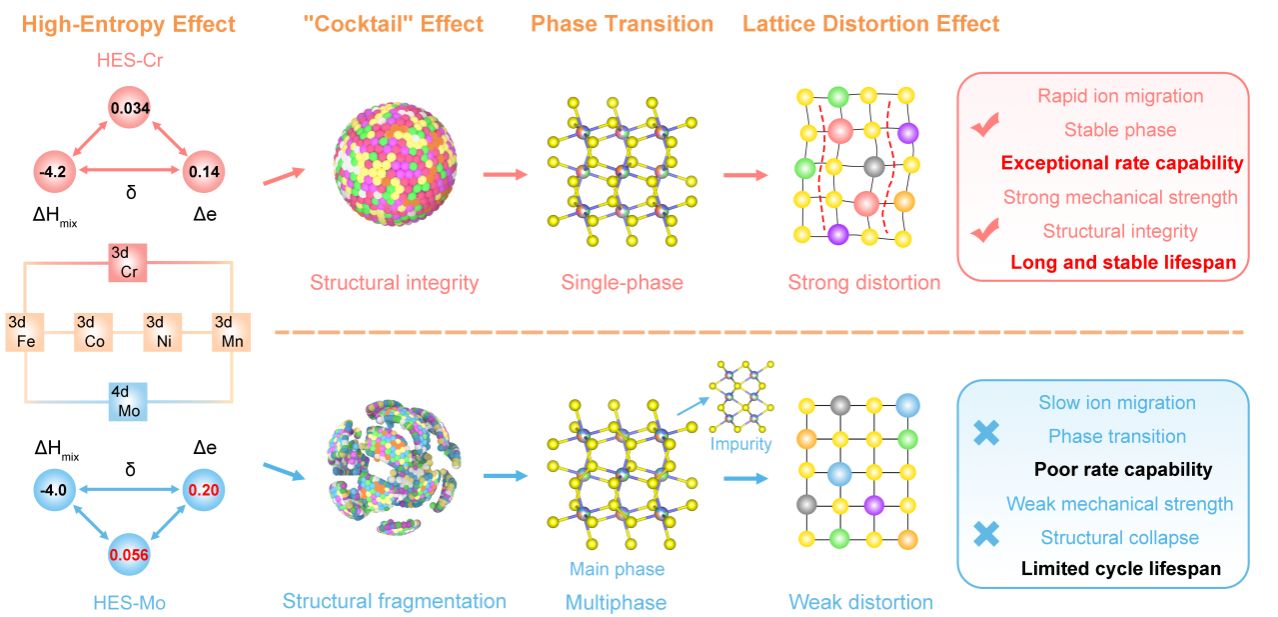
By screening material components against three core parameters — mixing enthalpy, atomic radius and electronegativity — the team synthesised chromium-doped single-phase high-entropy sulfide HES-Cr. Comparative tests with molybdenum-doped multi-phase samples verified that elemental matching is the core determinant of uniform single-phase structures, establishing fundamental principles for controllable phase synthesis.
Combining in-situ characterisation, first-principles calculations and finite element simulation, the team clarified three synergistic performance-enhancing mechanisms: electron delocalisation, lattice stress buffering and reversible interfacial conversion. A three-parameter quantitative prediction standard was established to reduce trial-and-error costs for new material development, offering a quantitative design tool for multi-element energy storage electrodes.
The research forms a closed-loop research workflow of “theoretical screening → precise synthesis → mechanism analysis → device validation”, revealing the intrinsic correlation between composition, phase structure and electrochemical performance of high-entropy sulfides and delivering a brand-new design framework for next-generation high-performance energy storage anodes.
Advanced Materials is a top-tier global journal covering energy, nanomaterials and functional materials with a latest impact factor of 29.1.