The academic paper “Multi-Signal Modulation Recognition Based on Frequency-Domain Sliding-Window Detection and Complex-Valued Neural Networks,” authored by Professor HOU Changbo from the College of Information and Communication Engineering at Harbin Engineering University and published in IEEE Internet of Things, has been selected as a globally top 1% highly cited paper in the field of computer science for 2026. The paper was previously named a top 0.1% hot paper in global computer science in 2023, and has been recognized as a top 1% highly cited paper in 2023 and again in 2025.
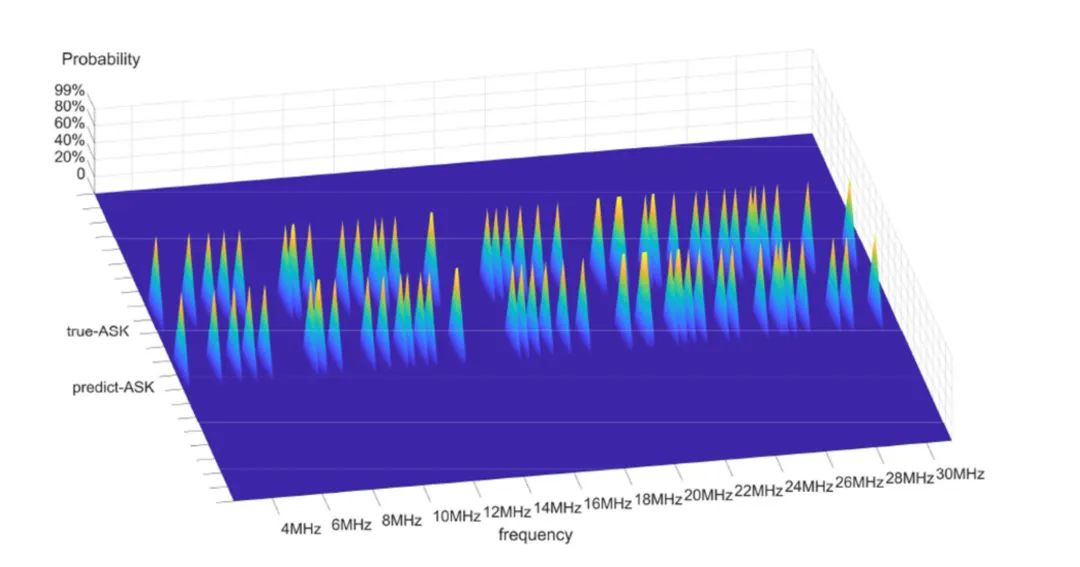
Aiming at the challenge of detecting and recognizing overlapping multi-signals in wide-frequency bands under low signal-to-noise-ratio (SNR) conditions, this paper proposes a frequency-domain detection and modulation recognition method tailored for multi-signal scenarios. It innovatively integrates a sliding-window detection mechanism with a complex-valued convolutional neural network. By applying fast Fourier transform to obtain the spectral information of time-domain overlapping signals, the method transforms the complex time-domain overlap problem into a frequency-domain separation problem. Based on an energy detection approach, the spectrum is segmented via sliding windows to enable adaptive detection of adjacent signals in the frequency domain. A complex-valued convolutional neural network is constructed to fully leverage both amplitude and phase information in the signal spectrum, thereby achieving accurate recognition of the modulation types of each constituent signal.
Experimental results demonstrate that under a low SNR of −2 dB, the proposed method can effectively recognize up to 264 overlapping signals with an accuracy of 97.3%. The method also reduces the impact of signal bandwidth variations on recognition performance, and can effectively detect and identify various signal types within the frequency band, providing a new technical pathway for intelligent multi-signal sensing in complex electromagnetic environments.
IEEE Internet of Things is a recognized premier journal in the field of the Internet of Things. By innovatively combining complex-valued neural networks with frequency-domain sliding-window detection, this research achieves a significant leap in detection and recognition accuracy under low-SNR and overlapping multi-signal conditions, and can be applied to electromagnetic signal interception, intelligent electromagnetic data acquisition, and related fields.