The 5th Academic Conference on Electromagnetic Spectrum was held in Harbin on 25 July. During the event, the Top 10 Scientific and Technological Advances in Electromagnetic Spectrum Field in 2025 was officially released. The project “Key Technologies and Applications of Adversarial Robustness Generation for Electromagnetic Spectrum Intelligent Perception Models”, led by Harbin Engineering University (HEU), was successfully selected.
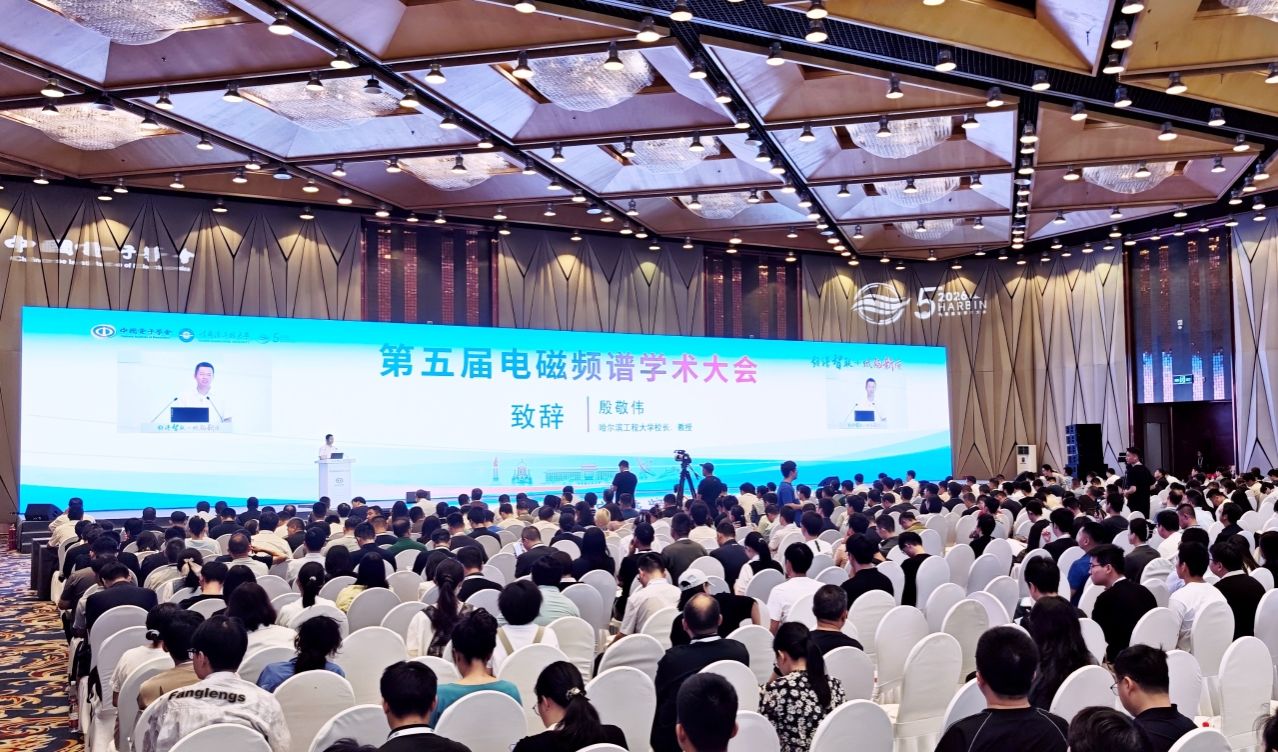
Academicians of the Chinese Academy of Sciences CUI Tiejun, HE Yuanzhi and YANG Kunde, Professor YIN Jingwei, President of HEU, CAO Xueqin, Deputy Secretary-General of the Chinese Institute of Electronics, JIN Cangsong, Director of the 23rd Research Institute of the Second Academy of CASIC, CHEN Xinyu, Director of the 22nd Research Institute of CETC, YE Tianchun, former Director of Institute of Microelectronics of the Chinese Academy of Sciences, and WU Qihui, Vice President of Nanjing University of Aeronautics and Astronautics, attended the opening ceremony. The event was presided over by Professor YIN Hang, Vice President of HEU.
President YIN pointed out that focusing on complex electromagnetic environments such as deep-sea platforms and space-air networks, HEU has made a series of breakthroughs in maritime resilient communications, air-sea cross-domain communications and cross-domain spectrum management and control. He expressed hope that the university would continue to deepen exchanges and cooperation with peer universities, research institutes and industrial enterprises, and contribute to enhancing China’s capacity for the development, utilisation and security of electromagnetic spectrum resources.
CAO Xueqin stated that this conference attaches great importance to the in-depth integration of artificial intelligence and electromagnetic spectrum technology, and strives to promote the application of scientific research achievements in emerging scenarios such as the low-altitude economy and space-air-ground-sea integration. The Chinese Institute of Electronics will continue to play its bridging role, advance original innovation and industrial deployment of electromagnetic spectrum technology, and support the high-quality development of the digital economy.
JIN Cangsong expressed hope that with this conference as a platform, all experts and scholars would work together to improve the collaborative innovation ecosystem, deeply integrate electromagnetic domain information such as radar and electronic countermeasures, and jointly promote fundamental breakthroughs, technological leaps and industrial upgrading in the electromagnetic spectrum field, so as to contribute more aerospace expertise and radar solutions to national development.
CHEN Xinyu noted that electromagnetic spectrum is evolving from a traditional “supporting element” into a key engine of new quality productive forces. The 22nd Research Institute of CETC is ready to work with all participating experts to continue its efforts in intelligent spectrum perception and management, and secure utilisation of electromagnetic resources, so as to contribute Chinese solutions to building a clean, orderly and secure electromagnetic environment.
After the opening ceremony, CUI Tiejun, HE Yuanzhi, YANG Kunde, YIN Jingwei, WU Qihui and YE Tianchun delivered keynote speeches on major national strategic needs, theoretical frontiers and the latest research progress in engineering practice.
The conference featured 4 journal column forums, 4 youth forums and 20 thematic forums, alongside a series of activities including academic paper exchanges, industry-university-research seminars, case presentations on research achievement transformation, and exhibitions of academic achievements, comprehensively showcasing new theories, technologies, equipment and industrial applications in China’s electromagnetic spectrum sector.