Recently, the team led by Professor REN Jing from the College of Physics and Optoelectronic Engineering at Harbin Engineering University (HEU) has achieved a new breakthrough in the field of radiation-resistant cover glass for space solar cells, developing a new type of lead-free cover glass for space solar cells that combines high light transmittance, high-energy proton shielding, radiation resistance, and lightweight characteristics. The related results, titled “Robust Lead free Cover Glass for Improved Radiation Protection of Space Solar Cells,” were published in the top aerospace journal Space: Science & Technology. Professor REN Jing and Dr. YE Jiaxuan from the College of Physics and Optoelectronic Engineering are the co-corresponding authors of the paper, LIU Hao is the first author, and HEU is the first completing institution.
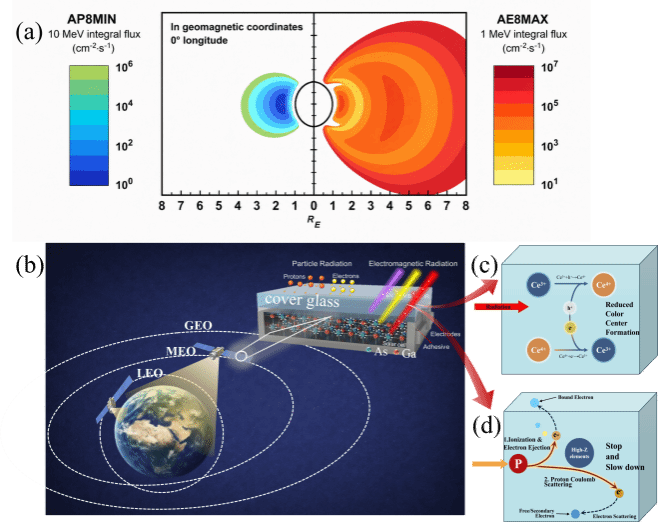
Schematic Diagram of the Space Radiation Environment and Its Interaction with Cover Glass
The team proposed a Gd/Ce co-doped lead-free silicate glass design strategy: enhancing high-energy particle shielding capability through Gd while using Ce to suppress radiation-induced color center formation, achieving synergistic optimization of multiple properties including high light transmittance, strong shielding, and radiation resistance. On this basis, the team also conducted tests on atomic oxygen, thermal shock, and device packaging compatibility to verify the material's practical application potential. Currently, the team has completed the development of a second-generation sample. Through further optimization of the material system and preparation process, the cost has been reduced by approximately 59% compared with the first generation, further enhancing the material's engineering application potential. Related research is continuing to promote the development of space solar cell protective glass from laboratory material research toward device applications and engineering.
Space: Science & Technology focuses on space science, space technology, and space infrastructure and services. It has been indexed in databases such as SCIE, EI Compendex, Scopus, DOAJ, and SAO/NASA ADS. The journal has an impact factor of 6.8, ranking 3rd globally in the Engineering, Aerospace category (3/55); it ranks Q1 in both the Astronomy & Astrophysics and Aerospace Engineering JCR categories, with a 2025 CiteScore of 9.9.
Original link: Https://spj.science.org/doi/10.34133/space.0754