Recently, Professor ZHANG Aman’s team from the College of Shipbuilding Engineering at Harbin Engineering University (HEU) published a paper in Journal of Fluid Mechanics, a top international journal in fluid mechanics. Titled “Interfacial instabilities and thermo-hydrodynamic mechanisms in high-temperature vapour-ventilated supercavitation”, the paper systematically reveals for the first time the interfacial instabilities and thermo-hydrodynamic mechanisms in high-temperature vapour-ventilated supercavitation, providing a brand-new theoretical basis for drag reduction technology of high-speed underwater vehicles. LIU Chunhao, a PhD candidate at the College of Shipbuilding Engineering, is the first author, and Professors XIONG Chengwang and WANG Shiping from the College of Shipbuilding Engineering are the corresponding authors.
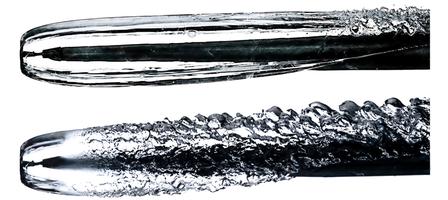
Supercavitation technology forms a gas cavity wrapping the vehicle surface through ventilation, greatly reducing water contact area and thus lowering frictional drag to an extremely low level. The team innovatively uses high-temperature water vapour as the ventilation medium and utilises the vaporisation of surrounding water to supplement the working fluid, which is expected to significantly extend navigation duration.
This research breakthrough extends the classic ventilated supercavitation theory, which mainly applies to non-condensable gas ventilation, to the complex multiphase flow problem of coupled thermodynamics, fluid dynamics and phase change mass transfer under high-temperature steam ventilation conditions. It deepens understanding of the thermo-hydrodynamic coupling mechanism of multiphase flow, and provides a theoretical foundation for research on the morphological evolution and stability regulation of high-temperature steam supercavitation.
Journal of Fluid Mechanics is a core journal published by Cambridge University Press in the UK. Founded in 1956 by renowned fluid dynamicist George K. Batchelor, it is widely recognised as the world’s leading journal in the field of fluid mechanics.
Original paper link: https://doi.org/10.1017/jfm.2026.11897