Recently, the 2026 Intelligent Hybrid Power Technology Conference was held in Hefei, Anhui.
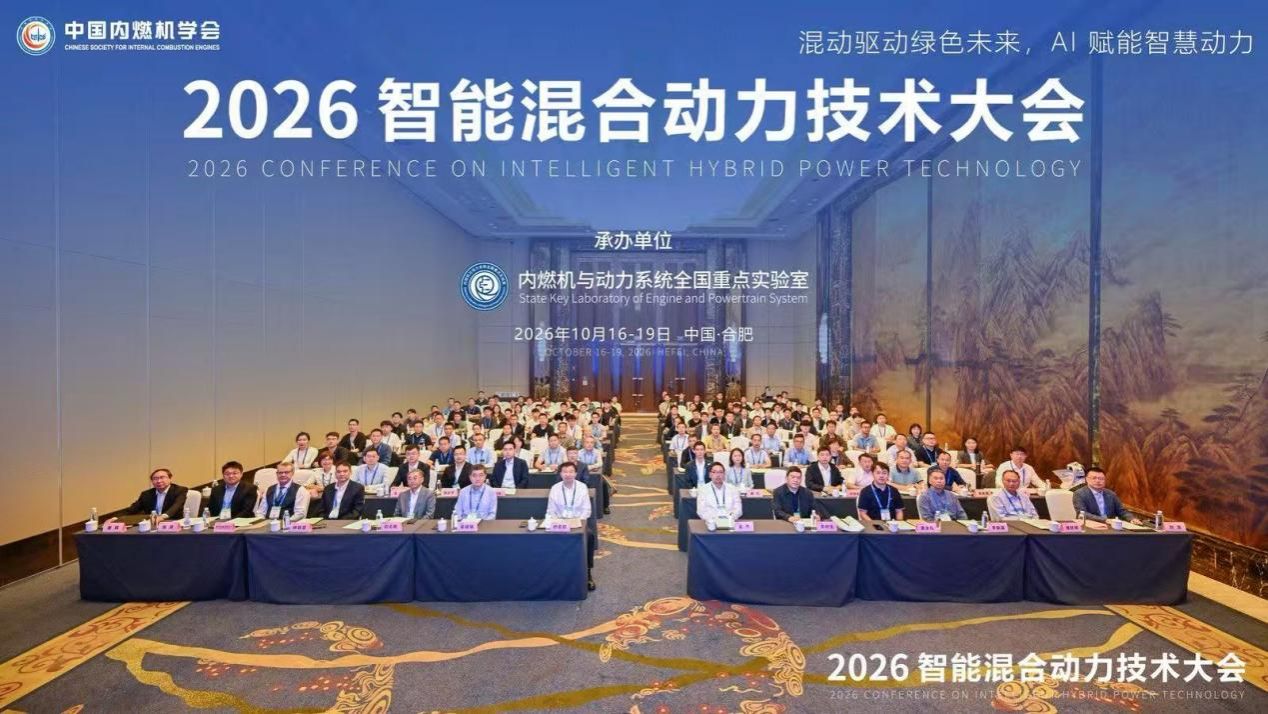
Experts and scholars at the conference focused on the theme “Hybrid Power Driving a Green Future, AI Empowering Intelligent Powertrains,” and conducted discussions on oil-electric/fuel-cell hybrid power, dedicated hybrid engines, and artificial intelligence control, among other directions, assessing key technical bottlenecks and exploring pathways for technological innovation and commercialization of research outcomes. Professor LIU Long of Harbin Engineering University served as conference chair.
SHU Gequn, Academician of the Chinese Academy of Sciences, and DOU Quanli, Deputy Director of the State Key Laboratory of Internal Combustion Engine and Power Systems, delivered remarks at the opening ceremony.
Authoritative experts delivered thematic reports, including LI Xianguo, Fellow of the Canadian Academy of Engineering; Alexander Stjerimakh, Foreign Member of the Chinese Academy of Engineering; LIN Tiejian, Chief Engineer of Guangxi Yuchai Machinery Co., Ltd.; TAN Zhixue, Assistant to the President of the Engine Research Institute of Weichai Power Co., Ltd.; Professor MOON Seok-soo of Inha University; YU Yunfeng, Principal Engineer of AECC Commercial Aircraft Engine Co., Ltd.; Professor JIN Chao of Tianjin University; HUANG Qianhai, Deputy General Manager of the Energy and Power Research Institute of Chongqing Seres Phoenix Zhichuang Technology Co., Ltd.; Professor QIAN Yejian of Hefei University of Technology; and ZHOU Tao, Deputy Dean of the Powertrain Design Institute of Anhui Jianghuai Automobile Group Corp., Ltd.
Five experts—Professor XU Xiangyang of Beihang University, Professor XIE Hui of Tianjin University, Professor LIU Long of Harbin Engineering University, ZHANG Zhifu, Executive Deputy General Manager of Chery Group Wuhu Acteco Powertrain Co., Ltd., and Professor SONG Kang of Tianjin University—jointly participated in an open discussion on topics such as hybrid system configuration innovation and AI empowerment, providing diverse perspectives for the selection of intelligent hybrid technology routes, innovation in control strategies, and future development directions.
The conference set up five thematic sub-forums, focusing on frontier directions to hold 40 invited presentations and 51 oral paper presentations, along with 61 poster displays and a graduate student forum, attracting 110 papers for exchange.
In parallel, the conference hosted the Intelligent Control Algorithm Challenge for Internal Combustion Power and the 2026 Zero-Carbon Power Inter-University Joint Graduate Seminar.
The Carbon Neutrality Research Institute of Harbin Engineering University will continue to base itself on the needs of national energy security and green, low-carbon development, leverage the university’s research and disciplinary strengths, deepen exchanges and cooperation with universities, research institutes, and industry enterprises, promote the interdisciplinary integration of power technology with frontier fields such as new energy and artificial intelligence, and contribute to the green and intelligent development of China’s power equipment and technological innovation in related industries.