Recently, Professor YANG Piaoping and Professor GAI Shili, along with their team from the School of Materials Science and Chemical Engineering at Harbin Engineering University (HEU), have achieved a breakthrough in piezoelectric catalytic tumor therapy. They proposed a novel strategy involving iron doping at the B-site to modulate the polarization characteristics and induce chemical bond reconstruction in rare earth hexagonal manganites. This approach significantly enhances the material’s piezoelectric catalytic performance and effectively induces ferroptosis in tumor cells. Guided by this methodology, animal experiments involving mice with heterotransplanted CT26 tumors demonstrated significant tumor suppression under ultrasound irradiation. This study marks the first successful application of rare earth manganate materials in piezoelectric catalytic therapy, offering a fresh perspective for utilizing rare earth functional materials in the “medical-engineering integration” field. It holds promise for advancing the design and clinical application of biomedical nanomaterials in China.
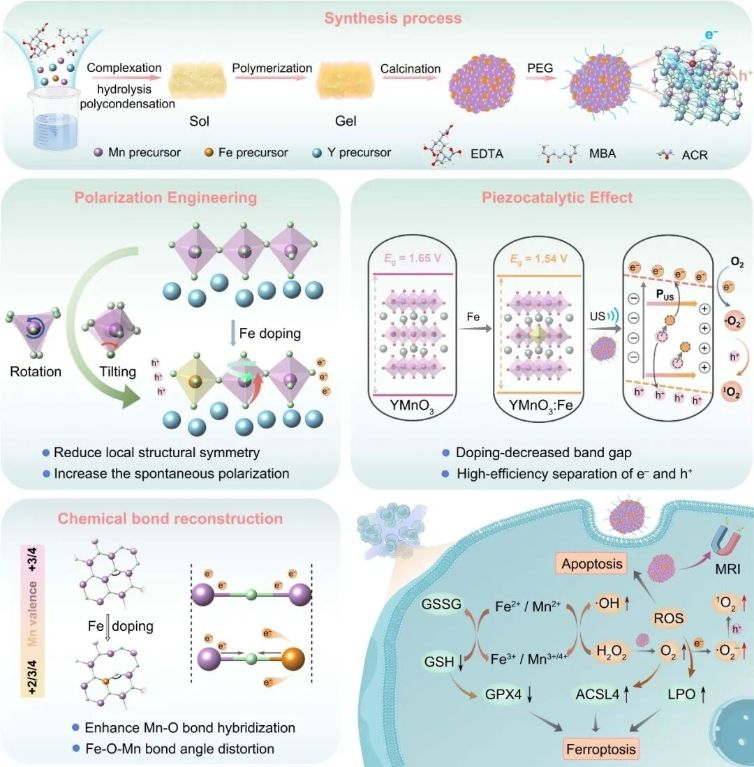
Schematic diagram illustrating the synthesis process of YMnO3: Fe NPs, along with their enhanced piezoelectric catalysis and therapeutic mechanism.
The findings were published in the prestigious chemical journal Journal of the American Chemical Society (JACS), under the title “Polarization Engineering and Chemical Bond Reconstruction in Rare Earth Hexagonal Manganites via B-site Iron Doping for Piezocatalytic Therapy and Ferroptosis”. YANG Meiqi, a Ph.D. candidate from the School of Materials Science and Chemical Engineering, is the first author of the paper. Professors GAI Shili and YANG Piaoping are the corresponding co-authors, with HEU listed as the primary affiliation.
Journal of the American Chemical Society (JACS), the flagship journal of the American Chemical Society, is a top-tier publication in the field of chemistry. It holds a Q1 ranking in the Journal Citation Reports and boasts an Impact Factor of 15.7 for 2024.