Recently, a research team led by Professor GENG Jing and Associate Professor ZHOU Yu from the College of Shipbuilding Engineering has achieved a significant breakthrough in the field of ocean wave energy. The team has revealed the energy transfer and capture mechanism underlying the coupling between parabolic wave-focusing coastlines and oscillating water column (OWC) wave energy devices. By leveraging the characteristics of wave fields reconfigured through energy convergence, they proposed and validated a novel single/dual-chamber OWC wave energy device configuration. This innovation substantially enhances energy capture efficiency and broadens the effective frequency bandwidth, offering a viable pathway to overcome the challenges of low-density and difficult-to-utilize wave energy in China’s coastal waters.
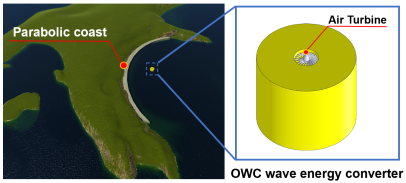
Placement of OWC wave energy converter at the focal point of a parabolic wave-focusing coastline.
The findings have been published in Communications Engineering under the title “Investigation of Energy Capture Enhancement in Oscillating Water Column Wave Energy Devices with Single and Dual Chambers in Converging Wave Fields.” Associate Professor ZHOU Yu from the College of Shipbuilding Engineering is the first and corresponding author, and Harbin Engineering University is the primary affiliation.
Communications Engineering is the first engineering-focused portfolio journal published by Nature Portfolio. It is an open-access journal dedicated to a wide range of engineering disciplines and aims to publish high-quality research, reviews, and commentary in the field.