A research team from the College of Shipbuilding Engineering, specializing in fluid–structure interaction, has recently achieved a significant breakthrough. Their study, titled “Jet formation in air bubbles induced by cavitation bubbles,” has been featured on the cover of the Journal of Fluid Mechanics, a leading journal in the field of fluid dynamics. The co-first authors are LIU Shiyu, a doctoral candidate, and WANG Bingqi, a master’s student, both from the College of Shipbuilding Engineering at Harbin Engineering University. The corresponding author is Professor ZENG Qingyun.
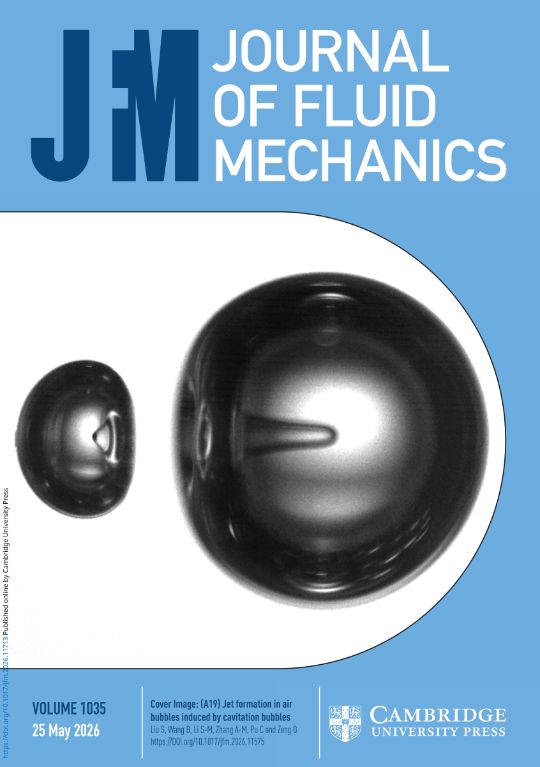
Through a combination of theoretical analysis, meticulous experimentation, and high-precision numerical simulations, the research team elucidated the complete physical process of jet formation in air bubbles driven by nearby cavitation bubbles. The study revealed that, depending on the relative distance and size ratio between the cavitation bubble and the air bubble, three distinct jet regimes can emerge: weak jets, strong jets, and explosive jets. The jet formation is not a single-stage event but unfolds in two clear acceleration phases. First, the shock wave generated by the collapse of the cavitation bubble imparts an initial velocity to the air–liquid interface. Subsequently, flow focusing of the liquid at the curved interface further accelerates the jet, serving as a secondary amplification mechanism. This dual-phase mechanism— “shock-wave initiation plus flow-focusing amplification” —successfully explains the origin of high-speed jetting.
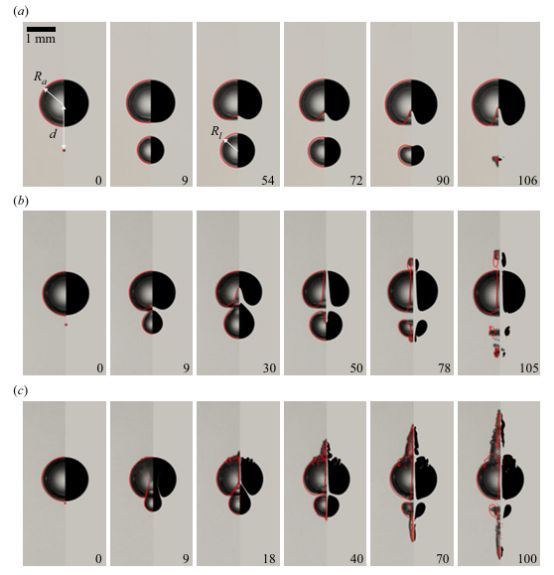
Experimental (left) and numerical (right) comparisons of the three jet types: (a) weak jet; (b) strong jet; (c) explosive jet.
The core innovation of this study lies in demonstrating that, unlike cavitation bubble pairs—which are highly sensitive to phase—air bubbles, acting as stable curved interfaces, offer a robust and fault-tolerant engineering platform for generating controllable jets when paired with cavitation bubbles. This finding not only deepens the fundamental understanding of bubble–bubble interactions in multiphase flows but also provides a direct theoretical foundation and a design roadmap for precisely tuning jet velocity, mode, and effects. The results hold promising applications in fields such as cavitation erosion protection for underwater equipment, cavitating flows around moving bodies, underwater micro-propulsion and robotics, and microfluidics and bioprinting.
The Journal of Fluid Mechanics, published by Cambridge University Press and founded in 1956 by the renowned fluid dynamicist George K. Batchelor, has an impact factor of 3.9.
Original article:https://doi.org/10.1017/jfm.2026.11575