Recently, Professor YANG Piaoping’s team from the College of Materials Science and Chemical Engineering at Harbin Engineering University (HEU) has achieved a breakthrough in cancer therapy. By combining grain boundary engineering–modulated ferroelectric catalysis with ultrasound-triggered in situ H₂O₂ generation, the team significantly amplified oxidative stress in the tumor microenvironment and achieved potent tumor suppression. The study, titled “Grain Boundary Engineering of Twist-Strained Ferroelectric Nanoparticles and the Enhanced Mechanism for Ferroelectric Catalytic Therapy,” has been published in the Cell Press journal Cell Biomaterials.
Ph.D. candidate LI Shuyao from the College of Materials Science and Chemical Engineering is the first author of the paper. Associate Professor YANG Dan, Professor GAI Shili, and Professor YANG Piaoping are co-corresponding authors. HEU is the sole affiliation.
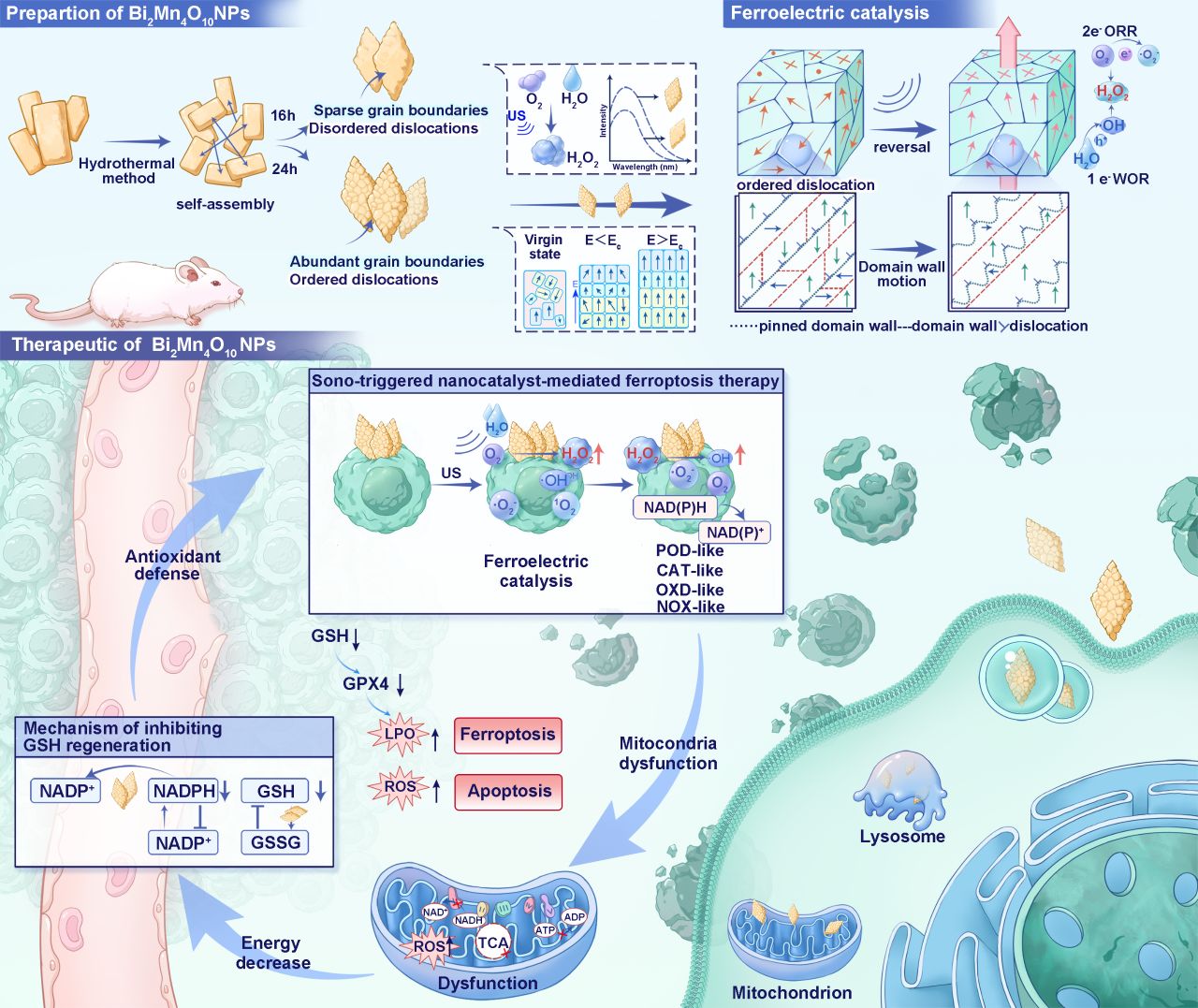
Schematic diagram of ultrasound-activated ferroelectric material–mediated catalytic tumor therapy.
In recent years, a novel catalytic treatment approach that relies on ultrasound to remotely activate materials and directly generate reactive oxygen species inside tumors has emerged as a promising strategy for truly “non-invasive and precise therapy.” However, conventional ferroelectric/piezoelectric materials face certain limitations, making it difficult to effectively target the deep, hypoxic, and antioxidant-rich tumor microenvironment.
In recent years, a novel catalytic treatment approach that relies on ultrasound to remotely activate materials and directly generate reactive oxygen species inside tumors has emerged as a promising strategy for truly “non-invasive and precise therapy.” However, conventional ferroelectric/piezoelectric materials face certain limitations, making it difficult to effectively target the deep, hypoxic, and antioxidant-rich tumor microenvironment.
To address this challenge, Professor YANG Piaoping’s team proposed an innovative solution: through structural design, they aimed to make ferroelectric materials “more flexible and efficient” in function. The research team utilized grain boundary engineering and strain modulation to fabricate Bi₂Mn₄O₁₀ ferroelectric nanoparticles featuring twist strain and multiple grain boundary structures. When ultrasound is applied to the tumor site, these nanoparticles act like “awakened” micro-scale energy amplifiers. They undergo polarization switching, continuously producing hydrogen peroxide and elevating reactive oxygen species levels within the body, thereby breaking down the tumor’s antioxidant defenses and precisely killing cancer cells. Additionally, this material possesses medical imaging capabilities, enabling “visible and accurate” tumor treatment.
This study not only provides a new material design paradigm for ultrasound-activated ferroelectric catalytic therapy but also opens up new possibilities for developing non-invasive, controllable, and imageable precision cancer treatment strategies in the future.
Cell Biomaterials, launched in 2025, is a new journal under Cell Press (Elsevier). As a sister journal to Cell, Matter, and Chem, it focuses on interdisciplinary areas such as biomaterials, materials science, bioengineering, and biomedical applications, and is highly regarded by scholars worldwide.